.svg)

.svg)

.svg)
.svg)
.svg)
Ice dams cause thousands in damage to GTA homes every winter. This guide covers what causes them, what they cost to fix, how to remove them safely, and how to prevent them for good.
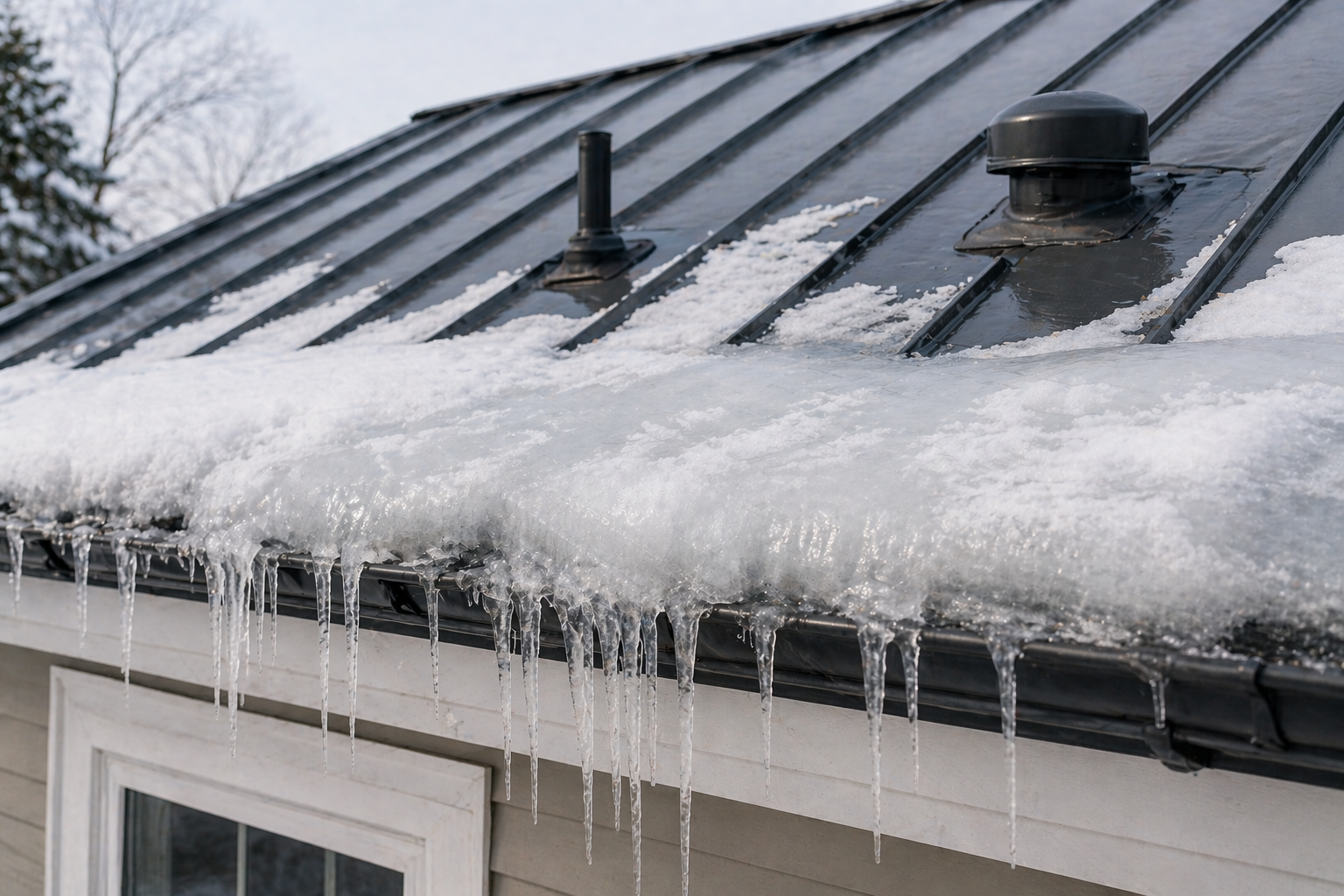
Most Ontario homeowners have seen ice dams at least once: the thick ridge of ice that builds up along the eave line in January, sometimes with icicles hanging below it and a suspicious dark stain on the interior ceiling nearby. What a lot of people do not realize is that the ice itself is not the problem. The ice is the symptom. The problem is what is happening inside the roof system that allows the ice to form in the first place.
This guide covers the full picture: why ice dams form in Ontario's specific climate conditions, what damage they actually cause, how to remove them without making things worse, and most importantly, how to prevent them from coming back.
Why Ice Dams Are Worse in Ontario Than in Colder Climates
This surprises people. You would think that colder places would have more ice dam problems, but the opposite is often true.
Ice dams form because of temperature differentials on the roof surface. The upper portion of the roof, over the heated living space, melts snow. The meltwater runs down toward the eave, which is cold because it overhangs the exterior wall and gets no heat from inside the building. When the water hits the cold zone, it refreezes. Over days and weeks, this process builds up a ridge of ice that acts like a dam, backing water up under the shingles and into the structure.
For a dam to form, you need snow on the roof, a warm upper surface, and a cold eave. Areas with consistently extreme cold, such as northern Manitoba in January, often have rooftop temperatures that are uniformly cold, so there is less differential. The GTA's climate sits in the worst possible band: average January temperatures that fluctuate around the freezing point, heavy snowfall events, and enough interior heat loss in older homes to drive the upper-surface warming.
The freeze-thaw cycle that defines GTA winters is also what makes ice dams here so persistent and damaging. Ice dams are among the most common roofing problems Ontario homeowners face, yet they are almost entirely preventable once you understand what is driving them.
What Actually Causes Ice Dams: The Three Factors
Every ice dam traces back to one or more of these three conditions. Fix these and you fix the ice dam problem. Treat the symptoms without addressing them and you are managing the problem indefinitely.
Inadequate insulation. If the floor of your attic is not adequately insulated, heat from the living space rises into the attic space and warms the underside of the roof deck. The surface temperature of the shingles rises above freezing even when outdoor temperatures are well below it. In Ontario, current building code calls for significantly higher insulation values in attic assemblies than what was standard in homes built before the 1990s. A lot of the ice dam calls roofing contractors receive in February are from homes built in the 1970s and 1980s with original attic insulation that has settled and degraded over decades.
Inadequate ventilation. Even with good insulation, heat and moisture accumulate in an attic space without proper airflow. The standard approach is passive ventilation: cold outside air enters through soffit vents at the eave line and warm air exits through a ridge vent at the peak. When soffit vents are blocked by insulation, which is common in retrofitted attics, or when ridge venting is absent, the attic runs warm and the dam-forming temperature differential develops.
Air leakage. Gaps around recessed light fixtures, unsealed attic hatches, improperly sealed bathroom exhaust fans, and penetrations around plumbing or electrical runs allow conditioned air to leak directly into the attic. This bypasses even good insulation. In older homes, air leakage is frequently the dominant driver of attic heat gain in winter. Sealing these pathways, referred to as air sealing in building science, often makes a bigger difference than adding more insulation.
What Ice Dams Actually Cost: The Damage They Cause
The ice buildup itself is sometimes the least expensive part of an ice dam event.
Shingle damage. As the dam grows, water backs up under the lowest courses of shingles. It forces its way through the self-sealing strip between shingles, saturates the underlayment, and reaches the deck. Repeated freeze-thaw cycling in this water-saturated zone lifts shingles, cracks sealant strips, and compromises the membrane. Repairing this properly means removing and replacing the affected shingles and, often, the underlayment beneath them.
Deck damage. Plywood or OSB decking that gets repeatedly wet and dried loses structural integrity. Edge swelling, delamination, and soft spots are all common. Replacing sections of decking adds to the scope and cost of a repair substantially.
Fascia and soffit damage. Ice dam meltwater running behind the gutter and over the fascia board causes fascia rot in wood-framed eave assemblies. This is a persistent problem in Toronto and Etobicoke neighbourhoods with older housing stock.
Interior water damage. When water breaches the deck, it runs along rafters, drips from ceiling joists, and eventually finds a path through the ceiling drywall or plaster. Remediation at this stage includes ceiling replacement, insulation replacement, and depending on how long the moisture was present, mold remediation.
A single ice dam season that goes unaddressed can run from $3,000 to $15,000 in combined roofing and interior repairs. For homeowners with older insulation and ventilation systems, this is not a one-time event. It recurs until the underlying conditions are fixed.
How Metal Roofing Changes the Ice Dam Equation
Metal roofing does not eliminate the underlying cause of ice dams: that is still a function of insulation and ventilation. But it changes the surface behavior significantly. The thermal mass and surface characteristics of steel or aluminum panels mean that the roof surface responds more quickly to outdoor temperature changes than asphalt shingles do. This reduces the window of time when partial melting creates runoff. More practically, metal roofs shed snow loads rather than holding them. A standing seam metal roof will often clear a snow load after a modest temperature increase, leaving little accumulated snow to melt and refreeze at the eave.
The other factor is that metal roofing, installed with a proper underlayment system and without fasteners that penetrate the surface as in a standing seam system, gives water nowhere to go when it does back up. There are no laps or joints for water to force through. The ice forms on top of the panel, but the panel itself keeps water out of the structure.
Homeowners with older asphalt roofs and chronic ice dam problems who switch to standing seam metal, combined with addressing attic insulation and ventilation, typically see ice dam activity drop dramatically or stop entirely. If you are weighing that decision, our metal roofing cost guide covers what that investment looks like in the GTA.
That said: metal roofing is not a substitute for fixing attic heat loss. A poorly insulated attic under a metal roof will still generate snow melting on the upper surface. The dam will form on top of the metal instead of working through shingle laps, which is better, but the water still needs somewhere to go.
Emergency Ice Dam Removal: What Works and What Makes Things Worse
If there is an active ice dam and water is getting into the house, you need to act. Here is the honest breakdown of options.
Roof raking. For ice dams that are forming but have not yet caused water infiltration, removing snow from the lower 4 to 6 feet of the roof with a roof rake, which is a long-handled tool designed for the purpose, eliminates the material that feeds the dam. This is the safest DIY intervention. Do it from the ground, pulling snow off rather than pushing it. Do not use a roof rake with a metal blade on an asphalt roof: the teeth will damage shingles.
Calcium chloride. The old advice is to fill a nylon stocking with calcium chloride and lay it across the dam perpendicular to the eave. The calcium chloride melts a channel through the ice, giving backed-up water a path to drain. This works, somewhat. It is slow and imprecise, and it requires getting on the roof or having enough reach with a rake to place the stocking accurately. Do not use rock salt or sodium chloride: it will corrode metal gutters and flashings and kill plants where the meltwater runs.
What not to do. Do not use a heat gun, blowtorch, pressure washer, or anything that involves direct heat application or high-pressure water on shingles or metal panels. Do not chop or chip at the ice with a sharp tool: every impact either damages shingles or the panel surface. Do not get on a snow-covered or icy roof without proper equipment and training.
When to call a professional. If the ice dam is significant, meaning more than a few inches thick across the full eave line, if water is actively entering the building, or if the roof pitch or height makes ground-level intervention ineffective, call a professional. Some roofing contractors and exterior restoration companies offer ice dam removal as a service. They use low-pressure steam equipment that melts ice without damaging the roofing surface. This is the right tool for serious dam removal.
Long-Term Prevention: What Actually Solves the Problem
Emergency removal addresses the immediate situation. Prevention addresses the cause.
Attic air sealing. This is usually the highest-impact intervention and the one that gets the least attention. Before adding insulation, have a contractor identify and seal air leakage pathways in the attic floor assembly. Recessed lights, plumbing penetrations, attic hatches, and any gaps around structural members are all candidates. This work often costs $1,000 to $3,000 depending on the scope and has an outsized effect on attic temperature in winter.
Insulation upgrade. Once air sealing is done, adding insulation to bring the attic assembly up to current code, which is R-60 in many Ontario applications, keeps heat in the living space where it belongs. Blown-in cellulose or fiberglass is the standard approach for retrofitting existing attics. The cost depends on current depth and attic area, but most GTA homes can be brought up to adequate levels for $2,000 to $5,000.
Ventilation correction. If soffit vents are blocked by existing insulation, baffles need to be installed before new insulation goes in to maintain the soffit-to-ridge airflow channel. If ridge ventilation is absent, adding a continuous ridge vent is a meaningful improvement. A roofer or insulation contractor can assess the current ventilation ratio against the attic area and identify deficiencies.
When a roof replacement is already planned, specifying an ice and water shield membrane, which is a self-adhering rubberized asphalt product, for the eave zone is standard practice in Ontario and required under provincial building code in many jurisdictions. Most roofing contractors in the GTA install it for the first 1.2 to 1.8 metres from the eave as a minimum. This does not prevent ice dams, but it prevents water that backs up under the dam from entering the structure.
Heat trace cables. Self-regulating heat trace cables installed in a zigzag pattern along the eave and through the gutter are a solution used in situations where attic insulation and ventilation improvement alone cannot fully solve the problem: typically in homes with complicated roof geometry, cathedral ceilings, or additions where the attic assembly cannot be easily accessed. They consume electricity and require maintenance, but they are effective. Installation by a licensed electrician is required.
Snow guards on metal roofs. On metal roofs, snow guards prevent large snow loads from sliding off in sheets. They break the snow into smaller masses that melt and drain rather than releasing all at once. This addresses a different problem than ice dams: sudden snow shedding from metal roofs can damage gutters, plantings, and anyone standing below. It is relevant for GTA properties where metal roofs are adjacent to high-traffic areas.
When to Call a Professional and When You Can Handle It Yourself
The dividing line is straightforward.
You can handle it yourself:
- Roof raking from the ground to remove snow accumulation before it feeds a dam
- Installing calcium chloride channels through a modest dam at the eave, if you can do it safely from the ground or a stable ladder
- Assessing from the attic whether insulation depth is adequate and soffit vents are open
Call a professional:
- Any time you need to get on a snow-covered or icy roof
- When ice dam removal requires more than surface-level intervention
- When there is any active water infiltration into the building
- When diagnosing attic ventilation or insulation problems, a professional roof inspection is the right starting point before any remediation work begins
- When adding insulation or heat trace, which require skilled trades work
The liability question is also real. If you are injured getting on an icy roof, or if you damage shingles or a metal panel surface trying to remove ice, those costs fall on you. Professional contractors carry workers' compensation and liability coverage for a reason.
How Seam Roofing Addresses Ice Dam Problems
When homeowners contact us about chronic ice dam problems, the conversation starts with the root cause, not the surface. We assess attic ventilation and insulation conditions alongside the roof system itself because solving ice dams at the roof surface without addressing what is driving them inside is a partial fix at best.
For replacement projects on homes with a history of ice dam damage, we specify ice and water shield for the full eave zone and valleys, verify ventilation is adequate before the new roof goes on, and recommend attic assessment if it has not been done recently.
If you are dealing with recurring ice dams on your home, or if last winter's events caused damage you have not fully assessed yet, reach us through our contact page to set up a roofing consultation.

.svg)
.svg)